Wednesday, 19 October 2016


Sunday, 16 October 2016

India & 500 Tests: a Perspective
In the
euphoria of recent successes, Indian cricket seems to have forgotten those who
laid the solid edifice of its massive modern structure. India began its tryst
with official Test matches way back in 1932 on a cold, windy morning at Lord’s
in the Marylebone district of London. The captain of the Indian team, Maharaja
of Porbandar
Natwarsinhji, in a magnanimous gesture handed over the captaincy
for the inaugural Test match to the more deserving ‘commoner’ and an
outstanding leader of men, C K Nayudu.
The fallacy
of the much-heralded issue that the Hindus do not get along with the Muslims
was exposed in next to no time as Mohammed Nissar, India’s fastest-ever fast
bowler, bombarded the formidable England batting arsenal in his opening spell.
The pride of the colonial masters lay in tatters at 19 for 3. Nayudu’s faith in
Nissar did not go unrewarded as Nissar responded with 5 prized scalps.
That early
morning spell of Nissar and Amar Singh sent a significant signal to the
cricketing world that a great cricketing nation was on the horizon. Those
magnificent Indian cricketers of the first two decades, 1930s and 1940s, could
not form a match-winning combination as only three official Test series, all
against England in England, were played before India’s independence.
With the
advent of partition of the Indian sub-continent, we lost some of our stalwarts
who stayed back in their homes which fell across the border. This was a mighty
blow to the emergence of India as a power in the international cricketing
firmament. If the land mass was not partitioned in 1947, one can well imagine
the strength of the ‘undivided’ team. This political decision set back sports
in the sub-continent by several decades.
Men of the
calibre of Vijay Merchant, Mushtaq Ali, Lala Amarnath, Vijay Hazare and Vinoo
Mankad, among others, were relegated to the footnotes of Indian cricket
history. Ironically, here in India our cricketing grandfathers have never
received their due recognition and reward. Men who had laid India’s strong
cricketing foundation since the days of Mehallasha Pavri, Baloo Palvankar and
Dinkar Balwant Deodhar came from all communities, all backgrounds and all
provinces. No particular group or region can ever take the credit for the stupendous
superstructure of contemporary Indian cricket.
India’s
first-ever Test victory came at Chepauk in 1952. Nigel Howard’s England (then
MCC) tasted an innings defeat as the world-class all-rounder Vinoo Mankad’s
left-arm orthodox spin flummoxed the English professionals. Mankad’s haul of 12
wickets in the historic effort was helped by centuries from Polly Umrigar and
Pankaj Roy. Jovial wicket-keeper Prabir Sen, born in Comilla (now in Bangladesh)
conspired with Mankad to bring about five ‘stumpings’.
Kanpur in
1959 proved to be the Waterloo of Richie Benaud’s star-studded Australians.
Under the leadership of Gulabrai Ramchand, India enacted a historic victory at
Green Park as off-spinner Jasu Patel wreaked havoc, with 9 and 5 wickets in the
match, after India had conceded the first innings lead.
In 1961-62
India defeated England for the first time in a series. Nariman Contractor’s men
had Ted Dexter’s outfit in total disarray at Calcutta and Madras. Motganhalli Laxminarsu
Jaisimha, Vijay Manjrekar, Chandu Borde and Salim Durrani were the outstanding
performers in the series.
Since 1932, India
went on to win 131 Tests out of the 502 played till today. Of these 131 victories,
India’s performance at home, as with all other nations, is far superior to its
performance abroad. So far India has won just 41 Tests abroad while winning no
less than 90 Tests under familiar conditions at home.
Sadly
India’s statistics of series victories abroad have not done justice to the
potential of our cricketers. Series victories on foreign soil have been far and
few. Just eleven series victories abroad in about 84 years of international
cricket is a poor index of the worth of India’s cricketing talents. This
scenario needs to be rectified soon.
Unfortunately
India had to wait till 1967-68 for her first Test and series victory on foreign
soil. Mansur Ali Khan Pataudi led from the front winning 3-1 against New
Zealand. The Kiwis had little answer to the wiles of Bishan Bedi, Erapalli
Prasanna and Bapu Nadkarni, while the batting honours went to Ajit Wadekar, gutsy
Rusi Surti and the ever-reliable Chandu Borde.
The wait for
35 years to win a Test abroad is a sad echo on the undoubted abilities of our
cricketers. The excellent Indian players excelled individually but failed
miserably to combine as a unit. Too many groups, too many diversions, too much
of bias had set in. Into that claustrophobic environment, the appearance of
Tiger Pataudi, bred in England, brought about a refreshing change. Communalism
and provincialism took a back seat. Young, deserving players began to feel
comfortable. The cricketing ambience in the country looked bright and relaxed.
The year 1971
will always be earmarked as the turning point of Indian cricket. Indian cricket
finally came into full maturity with magnificent victories over Garfield
Sobers’ West Indies in the Caribbean and over England in her own backyard.
Never before or after has India defeated two major powers of cricket abroad in
the same year. At the time there was no system of ranking of Test teams. But
India was certainly numero uno because England had just defeated both Australia
and West Indies.
The great victory
at Port of Spain in Trinidad against West Indies was possible because of the
dexterity of an Afghanistan-born Indian cricketer, Salim Aziz Durani. The
Kabuliwala was a cricketing genius who cared neither for fame or fortune. In
two successive deliveries he had Clive Lloyd and Sobers on bended knees. The
much-vaunted West Indians reeled under the gaze of the soft smile of the
handsome artist. He did not jump to celebrate. There was no awkward gesture.
Not a single curse escaped his lips. It appeared he was in empathy with the
vanquished batters. This was cricket at its best: modesty in victory. He
exemplified the spirit of cricket: the sport of gentlemen.
In this
series we saw the rise and rise of a short-statured, broad shouldered persona
named Sunil Gavaskar. Along with Dilip Sardesai, his senior Mumbai mate, he
went on and on to rewrite cricketing records galore. With Gavaskar’s
personality and performance on and off the field Indian cricket could no longer
be taken casually.
Skipper Ajit
Wadekar repeated his Caribbean victory by bearding the British lion in its own
den at the Oval with Bhagawat Chandrasekhar striking venom with his vicious
variety. India was actually on top of the cricketing world.
Despite the
usual wins, drawn matches and defeats in the following seasons, another
milestone in Indian cricket was the wins at Calcutta and Chennai against
Lloyd’s team in 1974-75. Two Tests down, Pataudi’s inspiring leadership,
Gundappa Viswanath’s magnificent batsmanship and Chandrasekhar’s magical spin
helped India to level the series before going down in the final encounter. Both
teams matched each other eyeball to eyeball. No quarters asked for; none
expected in return.
In 1976 at
Port of Spain India created a milestone in cricketing history. Under Bishan Singh
Bedi, India chased a total over 400 runs and won a magnificent victory.
Gavaskar, Viswanath and Mohinder Amarnath shone with the willow as Bedi, Srinivas
Venkataraghavan and Chandrasekhar took the bowling honours.
Then again
in 1981 came another superb victory at Melbourne under Gavaskar. The match was
heading for a certain defeat when Kapil Dev, Karsan Ghavri and Dilip Doshi
turned the apple-cart on the final day and helped India to draw the series.
In 1986
skipper Kapil Dev led India to a glorious series victory in England with
convincing victories at Lord’s and Leeds. Dilip Vengsarkar was outstanding with
unbeaten centuries in either Test, while Roger Binny, Chetan Sharma and
Maninder Sigh among the wickets. Kapil Dev proved to one and all that his
leadership qualities were no less inspiring than anybody else’s.
India next
series win over Sri Lanka in 1993-94 did not cut much ice as Sri Lanka was
still regarded to be among the minnows as were the ‘away’ wins over Bangladesh
and Zimbabwe.
But a unique
occasion was the magnificent victory over Steve Waugh’s Australians at Eden
Gardens in 2000-01. Despite following-on, Rahul Dravid (180) and VVS Laxman
(281) took up the challenge and posted a lead to aid Harbhajan Singh to run
through the Aussie innings with a hat-trick. Skipper Saurav Ganguly led from
the front as the next Test was also won and consequently the series. In the
annals of Test cricket, the Eden Gardens win was just the third occasion of a
team winning after following on. This was surely among the greatest victories
recorded in Indian cricket.
The next
series win ‘away from home’ was against Pakistan in 2003-04. Deputy captain Rahul
Dravid drew the first blood at Multan as the tour captain Ganguly completed the
operation at Rawalpindi giving India her first taste of a series victory on
Pakistani soil.
Rahul
Dravid, genteel and gracious, never got the credit for doing a yeoman job as
India’s captain. He was the captain when India won a series victory against
Brian Lara’s West Indies in 2005-06 and then later overwhelmed Michael
Vaughan’s England in 2007. He himself was outstanding with the bat as well as
in handling his peers. Unfortunately, the gentleman that he is, he has forever
remained in the background because of his impeccable conduct and low profile.
He is the only Indian captain to have helped the nation to win three Test
series abroad. Other Indian skippers have done extremely well at home, no
doubt, but Dravid was exemplary in leadership under difficult and non-familiar
conditions ‘away from home’.
Virat Kohli
and his mates deserve our kudos for India’s recent ‘away’ series victory in the
Caribbean as well as the current series at ‘home’ against the weak Kiwis. Now
it is up to these talented modern-day stars to rectify India’s poor record of
series victories abroad. They have given us a taste of it and every indication
that Indian cricket is about to set sail in full steam in the years ahead.
With Anil
Kumble as the guiding spirit, hopefully the emphasis on team ahead of self will
come to the forefront. The two Ks of Indian cricket – Kumble and Kohli – will
surely help India to be the King of world cricket.
Wednesday, 5 October 2016
ON TEST
SELECTORS

Only a test cricketer is qualified to select another test cricketer. So goes the candid logic. Extremely convincing, indeed. By the same token of analogy should an alleged criminal be judged only by a judge with criminal antecedents? By the way, should a cardiac specialist be a former heart patient himself? Who should do the post-mortem on dead bodies?
BCCI has
taken another step ahead. The national selector should not be more than 60
years of age. Why 60 and not 55 or 65 has not been specified yet. This
pronouncement means that men like Sunil Gavaskar and Bishen Bedi are not
qualified to be Indian national selectors at present. Probably some powerful
lobbies feel that Sunil having crossed 60 has become senile. More likely, that
‘brash’ Bishan cannot be pressurized.
Now the
question that crops up is very simple. If a selector is considered to be too
old at 60, what about the administrators themselves?
In the 85
years of India’s participation in test cricket, this season for the first time
ever the national selectors are being selected on the basis of applications
received in response to an advertisement. Very fair, no doubt. In this system,
every eligible candidate was given a fair chance to submit his credentials.
But then again
a simple query arises. Are the officials, who are picking the test selectors, former
test players themselves? Since the BCCI wants former players to select the
current international cricketers, it stands to reason that the test selectors
themselves should also be appointed by men who have played for India.
Earlier for decades the national selectors
were appointed by the powers-that-be without any definite guidelines. Every nomination
or appointment depended upon the whims and fancies of the respective zones.
Invariably enough, most national selectors would be malleable men who could be
easily influenced.
To escape
from that ridiculous system, the current BCCI administrators thought of a system
to rectify that scenario. Very praiseworthy indeed. But then the present system
hardly reveals any advancement on the previous one. BCCI should realize that a
selector should be a man of integrity, of knowledge, of sincerity. He must have
the courage of conviction and be willing to devote time and attention to his
job tirelessly. Very important, he must be totally unbiased and think of the
national interest first, last and always.
How many
tests or international matches the selector has played cannot be the primary
concern. His age is of no consequence. The man’s character and personality are
of paramount importance for this very responsible job.
Hundreds of
ridiculous instances concerning our national selectors over the years can be
cited. Here are a few that would give the reader a chance to know the kind of
men we have had as our national selectors.
Raj Singh Dungarpur had never represented India
but was almost single-handedly responsible for a 16 year old son of a low-profile
Marathi poet to make his test debut in 1989. In a span of about 25 years, SRT
went on to erase all possible batting records. Without Rajbhai’s selectorial
wisdom, Sachin’s advent at the international level would have been delayed. Former
first-class cricketer Raj Singh Dungarpur did more for cricket than any Indian
test cricketer or BCCI administrator ever did. Non test cricketer Raj Singh had
every conceivable quality a selector should possess.
Manindra
Nath Bechu Dutta Ray had no credentials as a player. But he was a first-class
umpire with the critical eye of a gem expert. He was the person who pitchforked
the young Sardar from Amritsar into the test team in 1967 at Eden Gardens.
Since that day the left-arm spinner went on to become one of the finest
left-arm spinners in world cricket. Dutta Ray showed little prejudice at the
national level, but was highly biased when it came to local club cricket. If
any young, deserving player from Bengal aspired to play for India then he had
to play for Bechu Babu’s Sporting Union Club in Calcutta.
On the other
extreme, we have had former test cricketer-turned national selector Ramesh
Saxena who did not even know the names of the players he helped to select.
Former test stars Dattu Phadkar and Pankaj Roy, by turns represented east zone
in the selection panel in the 1970s. Neither ever bothered to watch east zone
at play.
On the 1936
tour of England, Baqa Jilani was chosen for the final XI on the morning of the
Oval test because he willingly insulted and abused CK Nayudu publicly on the
specific instruction of his captain Vizzy! Shute Banerjee, who was way ahead in
performance and potential, was sidelined from the playing XI because he refused
to carry out such a vile order.
CK Nayudu on
his part as a national selector acted in a very high-handed manner to omit
Vinoo Mankad from the 1952 touring team to England. Mankad was at the time the
leading all-rounder in the world and had just helped India to win her
first-ever test victory with 12 wickets at Chepauk. Mankad had gone to UK to
play in the Lancashire Leagues when the Indian test team was to be selected for
the forthcoming tour of UK. Chief selector CK Nayudu insisted that Mankad
should come back to India to take part in a trial match! Mankad could not come
to India as he was engaged with his club and would have lost his contract.
Promptly CK Nayudu dropped him from the squad!
After India
lost the first test match at Leed’s, the manager of the team Pankaj Gupta cabled
Mankad in Lancashire at the time to join the team for the 2nd test
at Lord’s. Gupta did not even bother to ask the selectors for permission. As it
transpired, in that test Mankad dominated the proceedings in such a manner that
the test match came to be known as ‘Mankad’s Test’. Mankad with 72 and 184 runs
as well as 5 wickets was simply superlative. Just goes to show that a non-test
player’s vision (Pankaj Gupta’s) was far superior to that of CK Nayudu.
Highly principled
captain Polly Umrigar resigned from the test captaincy on serious differences
with the selectors just before the start of the Chennai test in 1958-59. For
the 1959 tour the selectors opted for DK Gaekwad as captain who was not even a
regular India player at the time. India had just Surendranath and Ramakant
Desai as genuine pacers for the 4-month tour of England! The series was lost
0-5. The national selection committee included former test cricketers like Lala
Amarnath, C Ramaswami and LP Jai with Dutta Ray, a first-class umpire and
non-cricketer.
For India’s
first-ever official tour of England in 1932 the Indian selectors opted for the
Maharaja of Porbandar Natwarsinhji, who supposed to ‘have more Rolls-Royce cars
than runs’ as a cricketer. His deputy was the Maharaja of Limbdi
Ghyanashyamsinhji, another man of very modest cricketing acumen.
But Natwarsinhji was magnanimous enough to
drop himself and ask the far more deserving ‘commoner’ CK Nayudu to lead the
team in the inaugural test at Lord’s. This generous gesture of Natwarsinhji has
been lost in the footnotes of India’s cricketing annals. What the prominent former
players and national selectors (Kanga, Hosie and Ashan ul Haq) were unable to
do, was done in a relaxed manner by the designated captain himself. This is
indeed unique in world cricket.
During his
tenure between 1969 and 1972, chief selector Vijay Merchant, well beyond the
age of 60, showed the gumption to select young talents and the future of Indian
cricket blossomed. Players of the calibre of Sunil Gavaskar, Gundappa Viswanath
and Eknath Solkar, among others, came into limelight with the ‘old and senile’
Merchant holding forth in the selection committee meetings. It is not a man’s
age but his worth that makes the difference.
Ghulam Ahmed
(61), Chandu Borde (49) and Bishan Bedi (37) belonged to different age-brackets and eras when they
were entrusted with the selection of the 1983 world cup squad. Such was India’s
disinterest in one-dayers at the time that selectors from east and central
zones (Pankaj Roy and Chandu Sarwate) did not even bother to attend the
selection committee meeting! This was actually a blessing in disguise for Bedi,
Borde and Ghulam Ahmed. The three very sincere, unprejudiced minds chose ‘horses
for courses’ and the rest is history, as the cliché goes. Just goes to show
that when India first won a world championship actually 3 national selectors
did the splendid job, although they were 5 in number. The emphasis cannot be on
the number of selectors. Nor on one’s date of birth.
Today Indian
cricket is at a crossroads. The caravan has travelled for 85 years since 1932
participating in 500 tests around the globe. Unfortunately India’s performance
abroad has not done justice to its actual potential. We have won a mere 11
series away from home including one in Bangladesh and another in Zimbabwe. 41
victories have been achieved on foreign soil whereas 87 on the familiar pitches
at home. This poor statistic needs to be altered for India to earn respect
abroad as a test team.
Ironically Indian test captains who have done
very well abroad have always been deprived of their due recognition. Ajit
Laxman Wadekar led India to two magnificent series victories against West
Indies in the Caribbean and against England in their own den in 1971. Yet he is
always regarded as a ‘lucky’ captain whatever that means! He is more remembered
for the disastrous 1974 England tour.
Another under-rated
India captain is the mercurial Kapil Dev Nikhanj. After the 1983 world cup
triumph, he led India to a most convincing 2-0 test series victory in England
in 1986. His inspirational leadership never earned any kudos. Why are we so miserly
in praising his leadership skills?
Similar is
the case with Rahul Dravid. He happens to be the sole India captain who has led
India to three series victories abroad against strong opponents. Deputising for
Sourav Ganguly at Multan in 2004, Rahul made the initial foray into Pakistan
territory till the captain-designate Ganguly came round to seal the series
triumph at Rawalpindi.
After taking
over, Rahul’s leadership paid immediate dividends in terms of series victories against
strong oppositions on their own backyard. He defeated Brain Lara’s Calypso men
in 2005-06 and the following year upset the apple-cart of Michael Vaughan’s
England. Yet the name of Rahul Dravid hardly figures when leadership skills are
discussed. Is it because of his low profile and his diffident nature?
Today with
Anil Kumble as the navigator and Virat Kohli in the driver’s seat, the trend of
India’s performance overseas requires urgent rectification. Hopefully the
encouraging results of the innumerable ‘home’ tests this season would not make
us complacent. Let the duo get the appropriate support from our national
selectors and help India to reverse our statistical record away from home.
Between 1932
and 1952 India would have just 3 selectors to do the job of selecting the
national team. Then from 1953 began the trend of having 4 selectors. This
pattern continued till 1970. From 1971 the national selection committee
comprised 5 men, one each from the respective zones.
Hence the
exact number of selectors is not of primary concern. Nor their age or the
number of test matches they have played for India. The principal issue is to
have men of integrity, sincerity and knowledge. Men who are unprejudiced and
would do their duty with the national interest in mind. Without fear or favour.
Thursday, 26 May 2016
Norman Pritchard

Norman Pritchard
Will the real Norman Pritchard please stand up? No way.
For years he has been dead and buried. Ignored and forgotten for ages.
Pritchard’s name and fame
rests on a tiny piece of statistic. He is credited to have won the silver medal
in 200 metres sprint and in 200 metres hurdles more than a century ago in the
Olympic Games at Paris in 1900.
Then, what is his relevance today? Plenty. He happens
to be the first Indian to win an Olympic medal.
Most
unfortunately Norman Pritchard’s qualification of being from India is being
questioned. Initially, the Olympic records acknowledged that Norman Pritchard
represented India at the Paris Olympic in 1900. By that reasoning he becomes
India’s first medal winner at the Olympics.
But recently Olympic authorities are unwilling to pass
on the credit to India as they feel that Pritchard should be considered a
British athlete as his parents were from England.
Since Pritchard’s life has never been properly
documented there is good reason to feel that the son of English parents should
be considered to have represented England. But at the same time let there be no
doubt that whatever little information is available about Norman Pritchard
points to the fact that he was a Calcutta-based man since birth.
Born in Alipore, then an exclusively British part of
Calcutta, Pritchard studied at St.Xavier’s Collegiate School in Calcutta.
Sports researcher Gulu Ezekiel has
discovered that he stayed at Lansdowne Road (now Sarat Bose Road) and worked
for Bird & Co, both at Calcutta.
There is no doubt that while at the Paris Olympic,
Norman Pritchard was very much a Calcutta lad. Pritchard excelled both at
football and rugby. A popular man, he was also the secretary of Calcutta
Football Club (CFC, now CC&FC). He also became the secretary of Indian
Football Association (IFA). Hence to regard a man, who was born at Calcutta and
spent all his active years in India, an England representative at the Olympic
Games is grossly unfair.
With such strong recommendations to back his candidature
as an Indian representative, it is indeed rather surprising that he is recently
being dragged away from India under extremely unpalatable circumstances. The
trail of Norman Pritchard was lost during the 1st world war. It
became impossible to trace the latter part of the life of the outstanding
athlete and prominent sports administrator.
About ten years ago while researching at the
Goethall’s Library of St Xavier’s College, Calcutta, I came across a newspaper
cutting mentioning that Norman Pritchard had gone across to United States and
settled down. This piece of information helped in getting to know the actual
fate of the great athlete from Calcutta. In the US, the athlete Norman
Pritchard became a movie actor! He was an extremely popular star and acted in
numerous films under the name of Norman Trevor. Unfortunately he led a reckless
life and died in penury. He has been forgotten ever since.
The late lamented Reverend Cecil Leeming, a priest of
English parentage at Calcutta St.Xavier’s, who was good enough an athlete
himself to be called for the 1936 Berlin Olympic trials, always maintained that
although Pritchard had British parents, he was an inspiration to a generation
of Calcutta athletes and would never have considered himself to be anything but
a ‘pucca’ Bengali.
Pritchard went to the Paris
Olympic in 1900 on his own. He was sent neither by India nor by Britain. Hence
Pritchard’s two silver medals remain his very own. Since he was born and bred in Calcutta, there is no earthly reason to
think that he went to Paris as an England representative.
If Pritchard is now considered to be an England
athlete, then what would be the status of cricketer Ranjitsinghji? Ranji was
not born in England nor did he have English parentage. Yet, based in England,
he represented England. India accepted that he was an England cricketer by
residential qualification.
If Ranji is considered an
England cricketer by residential qualification, then Pritchard most certainly
would qualify to be an athlete representing India for the very same reason. Let
sanity be restored. Norman Pritchard, the Calcutta lad, is India’s first
medallist at the Olympic Games.
In this year of Olympic
Games, let all genuine sports lovers not forget the name of the man who first
brought laurels to India at the Olympic Games.
Saturday, 30 April 2016
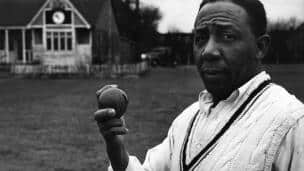
Sir Learie Constantine
At Eden the other day when Carlos Brathwaite was plundering the England attack with those towering sixes, one could see the ghost of Learie Constantine hovering around him.The power and precision-timing of Brathwaite’s bat merely exemplified the spirit of the man who was among the first to entertain the cricket world with incredible and uninhibited stroke-play.
At the turn
of the 19th century, WG Grace had laid the foundation of classical
cricket technique. Ranji had revealed the artistry of the Orient with his
wrist-work. Trumper had shown the fearlessness of youth. Jack Hobbs his technical
perfection under all conditions, even on the ‘stickiest’ of pitches. But with
the arrival of Constantine from the Caribbean a novel dimension was added to
the repertoire of cricket: entertaining cricket without a bother for the
morrow.
The West Indies
squad for the world T20 championship seemed to reflect the varied charms of the
master entertainer, Learie Constantine. Gayle’s big-hitting with gay abandon,
Russel’s boundless energy, Bravo’s variety in bowling, Samuel’s cool planning,
skipper Sammy’s perpetual smile were all reminiscent of the man. Constantine
represented not a region, but a race. He represented not an era but an aeon
that went beyond a century. Constantine’s charisma has rubbed off on his
cricketing grand-children and great-grand-children.
His ebony
complexion and curly hair reflected the soul of his land. Life was short and
was to be enjoyed. Live life to the full: sports and spirits; dance and drums. Enjoyment
and entertainment are to complement each other. The spontaneous effort was all
that mattered. The outcome, even if successful, was totally secondary to the
creative urge. The result was less important than the means. Constantine took
his front-foot wide outside the off-stump and swatted the ball over the
mid-wicket fence! Sacrilegious in the 1920s. The coach shouted, “Look where
your feet are.” A broad grin emerged, “Sir, look at the ball, forget the feet.”
He was
indeed a revolutionary in the ethos of the time. The contemporary Englishmen
depended on well-tested conventional techniques and strategies. The South
Africans were in the Brit mould. The Aussies were a little different. They
relied on orthodox ideas but were distinctly more aggressive. But with the
arrival of the coloured West Indian, the whole perspective of cricket underwent
a radical change. The transformation was the signature tune of Learie
Constantine.
When not
swatting the ball, he would hurl thunderbolts at the batters and laugh at the
latter’s discomfiture. If the batter was a dear friend, then he would get more
bouncers and guffaws from his friend ‘Conny’. Once, Wally Hammond had a taste
of the chilling fury of his close pal. A well-directed, menacing bouncer split
open Hammond’s chin, the mark of which was to last a lifetime.
Constantine
had the uncanny habit of sweeping the ball behind the wicket-keeper. If it took
his fancy he would bowl spin off a long run-up or bowl pace from a few strides.
For providing unalloyed excitement, Learie Constantine had very few parallels.
Sir Don rated him to be the most enterprising of cricketers.
Learie
Constantine is dead and buried. Long gone into the sands of time. But the
spirit of the radical lives on. Every Caribbean cricketer is born with a big
enough drop of Constantine’s blood. The crimson with an electric hue.
Physical power
he possessed in abundance. The lithe elastic body carried a bundle of energy. Seemed
to be in a state of perpetual motion. Even after the end of the run-up, Constantine
would scamper to field the ball wherever it was. With every movement, he
appeared to be accumulating energy. Once Constantine actually caught Andy
Sandham off his own bowling when the defensive prod had popped the ball just about
three yards down the pitch!
Muscular yet supremely supple, he released the
ball at fearsome pace yet never lost his cool. Highly respected not only for
his brilliant mind, but more so for his magnanimous nature. No opponent has
ever been so revered, except perhaps his own protégés like Frank Worrell and
Gary Sobers.
Although the
Trinidadian was ever ready to laugh at his own follies and failures, he was
till the last day a rebel in approach. This was the difference between him and
the other great pioneers of the game. Constantine would never seek self-glory
or self-publicity. Would never disrespect others. Would be the first to stick
his neck out, especially on race-relations and other social issues. Learie
Constantine completed his bar-at law and later became the high commissioner of
Trinidad in Britain. An exemplary role model from all angles. Unfortunately
today in the world of cheap publicity, his happens to be a long-forgotten name.
Cricket-wise
he came under the guidance of English coaches as a youngster in Trinidad. But
he went far beyond conventional thinking and classical techniques. He adapted
the game to his genes. A very high back-lift and a complete follow-through of
the bat between the shoulder blades. Jumped out, even to pace bowlers, to lift
the ball high, wide and handsome.
Between the
wickets no leopard could out-run the born athlete. He was without a trace of
doubt the best fielder of his generation and beyond. From 75 yards his unerring
throw would be on top of the bails. Incredible catches he took through sheer
athleticism.
The typical
West Indies mould developed with the arrival of Constantine. He was a child of
nature. Gave full vent to his feelings. No inhibitions, no anxiety, no theory
ever bothered him. Today’s West Indies cricketers follow the pattern set by him
in 1920s. It is in their genes. The spirit of adventure is what sets the West
Indies cricketers apart from all others. They are spontaneous, highly spirited,
fun loving, born entertainers.
Constantine
is still rated to be the best-ever performer in the Lancashire Leagues, the
precursor to the over-limit format. Not only because he was very successful but
because his presence would guarantee entertainment for the spectators. His sole
intent was for the benefit of the audience.
Following
his tenets, West Indians in the following generations have proved themselves to
be among the most prominent entertainers. Time and again they dominated the
world cricket scenario, particularly in the 1970s and 1980s, but their real
appeal lay in their entertainment value in all formats of the game.
West Indies
cricket has suffered for over the last two decades for various reasons. Now
with the new-found successes – men’s team, women’s team and u19 team – it may
appear that a turnaround is just round the corner. Whether West Indies as a
team is successful or not, there is no semblance of doubt that individually the
Caribbean cricketers are still the most entertaining and exciting of all.
The West
Indies team may not be able to replicate its earlier successes but the entertainment
value of the Caribbean cricketer will never falter. The spirit of Constantine
is still in full flow in their veins. The charisma of Sir Learie Constantine (knighted
in 1962) has gone beyond boundaries, has traversed a century. He stands supreme
among the great entertainers of the cricketing pantheon. Sir Learie is the
fount from which spring the enterprise, the excitement and the entertainment
value of the Caribbean cricketers..

Wednesday, 6 April 2016

On
Dhirubhai Ambani’s patriotism in the cause of cricket
Dhirubhai
Ambani has just been posthumously honoured by the Government of India with the
coveted award of Padma Vibhushan for his unparalleled contribution to the
Indian industrial environment. The sheer magnitude of Dhirubhai’s achievement
in the industrial sector has dwarfed many of his other stupendous work in the
interest of Indian society. One of his magnificent achievements is in the arena
of cricket. Sadly the issue has never been highlighted in our country. His
yeoman contribution to cricket has never been acknowledged and recognized.
Dhirubhai
Ambani happens to be among the eminent pioneers who gave cricket in India a new
and novel dimension. He exemplified the spirit of patriotism in no uncertain
manner on a monsoon morn in Mumbai way back in1983. He picked up the phone
receiver and gave his assent as the voice from the prime minister’s office
informed him to meet the prime minister within a couple of days.
The
visionary industrialist did not have a single query. Nor did he want to know
the reason for the urgency. Dhirubhai wasted no time. Next day he was at Mrs
Indira Gandhi’s chamber at 10 Janpath in New Delhi to keep his appointment as
desired by the prime minister herself.
NKP Salve,
the president of the Board of Control for Cricket in India, was also asked by
the PMO to be present in the room at the appointed hour. Salve happened to be a
cabinet minister at the time and was very highly rated for his integrity as a
lawyer as well as a politician.
Prime
minister Mrs Gandhi kept the usual pleasantries short, as was her style, and
went straight into the principal issue. She asked Dhirubhai whether the latter
would be keen to sponsor a world cricket championship on Indian soil. Dhirubhai
Ambani, God bless him, did not hesitate for a moment. Instantly he realized
that the image and prestige of his nation was at stake. He nodded and uttered,
“Madam, yes, I would be too happy to give a blank cheque to cover the entire cost
of the tournament since it is for a national cause.”
He did not
betray any emotion. He asked no questions. He sought no clarifications. The
grand ol’ man immediately grasped that the money was to be spent to uphold
India’s honour. For him that was enough reason. He offered a blank cheque. Yes,
that was Dhirubhai Ambani. This is a glorious example of how politicians and
industrialists can come forward for the cause of the country through the
popular medium of sports.
But we are
going ahead of the actual story. The story begins at Lord’s. June 25, 1983 to
be precise. India had reached the Prudential World Cup final against all odds.
“Kapil’s Devils” were to play the defending champions, the rampaging West
Indies at the Lord’s.
A few days
prior to the final, just after India had defeated the hosts England in the
semi-final, the BCCI president NKP Salve requested the authorities at the
Lord’s for 2 tickets for the final. The tickets were requested for Siddhartha
Shankar Ray and his wife Maya. SS Ray, a former Calcutta University Cricket
Blue, was at the time the Indian High Commissioner to USA.
Surprisingly
the authorities at the Lord’s turned down the request of the BCCI president.
Even priced tickets were not made available. For Salve, the epitome of
gentlemanliness, this was an embarrassing scenario. The president of one of the
finalist teams could not offer just two tickets to an Indian ambassador. NKP
Salve, man of high integrity and self-respect, decided there and then that he
would not take this insult to his country lying down.
When India
won the coveted trophy, the president of BCCI NKP Salve lost no time and
brought the winning team over to New Delhi from Heathrow to meet the prime
minister. After the reception was over, Salve made a beeline for Mrs Gandhi and
told her of the humiliation that he had to face in London over those two
tickets.
Mrs Gandhi
asked Salve what he had contemplated to avenge the insult. Salve, the
outstanding lawyer and clever politician, had a mind of his own. He devised
that he would try to get the world cup out of the clutches of England who had
monopolized hosting quadrennial tournament since 1975.
Within the
course of the next few months the BCCI was keeping themselves prepared to take
on the challenges of the major cricketing powers of the time, England and
Australia. It was decided that at the next meeting of the ICC, where the dates
of the following world cup in England would be decided, the BCCI would offer
double the guarantee money to all the participating teams. On the day of the
meeting at Lord’s, true to form, the plan was executed to perfection.
At the ICC
meeting held at the Lord’s to confirm England as host, the eloquence of NKP Salve
had the influential lobbies scurrying for cover. In a magnanimous gesture, the
BCCI president doubled the guarantee money if the tournament was held in India
and then, for good measure, made some more concessions for the benefit of the players
and their families. All reservations about playing the world cup on Indian soil
evaporated into thin air in next to no time.
The ultimate decision of the meeting heralded
that the 1987 edition of the world cup would be held in India. In another
master-stroke of diplomacy, the statesman in NKP Salve asked Pakistan to be a
co-host. The 1987 world cup was the first world cup in cricket to vanquish the
monopoly of England as the permanent venue. Since then the world cup
championship keeps moving around the globe by rotation as it should be in a
democratic scenario.
The spirit
displayed by Dhirubhai Ambani, NKP Salve and Mrs Gandhi has been forgotten in
this land of ours. They showed the way how politicians, professionals and
industrialists can help to shape the world through the medium of sports.
But the
juggernaut, massive and strong, was too good to last. Mrs Gandhi was
assassinated in October 1984. The country was in turmoil. The world cup was
only of secondary importance. Obviously enough, there were far more important
jobs awaiting attention.
But Salve
had other ideas. He approached Dhirubhai to find out if he was still willing to
sponsor the world cup. Salve’s apprehension can well be imagined. Indira Gandhi
was no more. The nation was staring at a crisis after a crisis. But the
industrialist from Mumbai said, “Nothing doing, the show must go on. I will not
go back on my word.” As promised, the blank cheque from Dhirubhai Ambani remained
with BCCI’s Salve.
Rajiv Gandhi
took over from his late mother. Salve kept his unwavering focus. On his part,
the patriot Dhirubhai, who had no interest in sports, sent his younger son Anil
to get involved with the staging of the world cup. In one grand gesture of magnanimity,
Anil Ambani had all the cricket boards salivating.
Anil offered
complimentary hospitality to all the office bearers of the respective cricket
boards. This was purposely done just to add salt to England’s wound. People who
had denied India just two tickets were granted full hospitality throughout the
course of the championship! It was an exemplary Gandhian master-stroke by the
Reliance owner.
The trio –Salve, Ambani and Gandhi – was
magnificent in handling the global event. The Reliance Cup was an outstanding
success in terms of media coverage, sponsorship and crowd participation. Just
goes to show that with the right people in right places, India can move the
world. Dhirubhai Ambani deserves our salute for his superlative, patriotic
gesture.
Tuesday, 15 March 2016

Syed
Mushtaq Ali
The
first time I saw Syed Mushtaq Ali was at the Eden Gardens in the “Defence Fund
Match”, which was held following the India-China war in 1962. At the time in
the early 1960s, Mushtaq Ali was nearing 50 and most certainly was out of
cricket for more than a decade.
In
our childhood days, I had heard of Mushtaq Ali’s magnificent exploits from my
father and uncle Tarun, who used to play club cricket in Calcutta. They would
mention how he would step out of his crease to even fast bowlers and glance or
cut with ease. That was supposed to be his trademark stroke.
To
be honest, it was difficult to believe that such a stroke was possible. Why
should a batsman step out to a fast bowler? And even if he did, why would he do
so to glance or cut the ball? It just
did not make sense. It sounded incredible. I used to think that since my father
and uncle belonged to Mushtaq Ali’s generation, they were merely exaggerating
the hero worship of their idol.
Now,
I was watching the 50 year old former opener against the fastest bowler in the
world at the time, Roy Gichrist of West Indies! A man of immense pace and ferocious nature. As
Gilchrist, arms flailing, thundered in to deliver, Mushtaq Ali actually stepped
out of his crease! He must have stepped out at least two yards!
Gilchrist,
flabbergasted, did not release the ball. He ran down the pitch to Mushtaq Ali’s
end, glared at him for a while and made a sign of the cross on Mushtaq Ali, as
if marking the target before turning back to bowl the next ball. Mushtaq Ali merely
smiled and made a gesture of flicking a speck of dirt from his fluttering silk shirt.
The
whole episode was the height of showmanship. But this was no theatre. A spark
had been ignited between the world’s fastest bowler and the world’s most
adventurous batsman. The stark reality of antagonism was palpable. The crowd
was on the edge of their seats. We realized that there would be no quarters
given; certainly none asked for. The intervening moment throbbed with
excitement: a fuming Gilchrist walking back to the top of his distant bowling
mark; and Mushtaq, nonchalant and graceful, leaning on his bat for support.
The
next ball from the fearsome Gilchrist scorched the earth but the old man was
again out of his crease in no time and flicked the rising delivery off his
chest over square leg to the fence. It was a combination of raw courage,
superlative co-ordination of hand and eye and sense of adventure.
I
had seen enough. Realised there and then, the reason for generations of cricket
lovers to idolize Mushtaq Ali. He was not only a marvellous batsman, full of
strokes and audacious nature. No, no, he was much more. For him cricket was not
only a game, but an adventure. An adventure to be enjoyed and to be lived to
the full. If the adventure did not end in glory, there was no failure involved.
It was just a matter of challenge.It was the sense of attempting the impossible
that set him apart from others. Never before or since has a batsman stepped out
to the fastest of bowlers to cut the ball or to glance or to flick. None would
dare because it was risky. In fact that was precisely the reason why Mushtaq
Ali patented that stroke of his: because it was difficult to execute and
because it was risky even if executed properly.
In
the 1970s I played against his son Gulrez Ali in Duleep Trophy matches. He had
his father’s easy bearing, relaxed smile and cultured manner. There, however,
the comparison ended because there could not be another graceful and gracious Mushtaq
Ali, not even among his own progeny.
In
1993 Mushtaq Ali had come at the invitation of the Voluntary Blood Donors’
Association to meet the blood donors at Eden Gardens, of whom I happened to be one.
I had taken a copy of his autobiography Cricket
Delightful and requested him for his signature. Flashing a wide smile, he
put down his signature and wrote, “Hope one day you play for India.” It was
very embarrassing and so I told him, “Sir, I am 43 and have given up active
cricket.”
Without
any hesitation he smiled again, “You never know. They might call you for the
India Veterans XI.” Believe it or not, by the end of that year I was actually
in the India Veterans team.
After
the blood donation camp was over, I invited Mushtaq Ali to the CAB indoor
stadium to meet the Bengal Under-16 team members, who were my wards. There even
before we could even request him, he volunteered to bat! He was nearing 80 at
the time. Still ramrod straight and without an iota of excess fat, his statuesque
bearing evoked instant admiration. Most of the bats he found rather heavy, as
contemporary bats are. Finally he picked up a comparatively light bat and was
ready to face the bowling without any protective gear. I asked an off-spinner
to bowl. Again he stepped out of his crease and this time he cut the ball with
immaculate timing!
It was not the rapier thrust of a cut. No, it
was a whipping action of steely wrists. Simply amazing the stroke was. At the
age of 80 in totally alien conditions how did he manage to time the ball is
beyond my comprehension. But he did it. We saw it and were mesmerized. Never
before had he played under artificial lights. Never before had he played on
artificial surface. Yet he revealed to us what genius really was.
Later,
I requested him to advise me and my trainees. The modest man said, “My
philosophy is enjoy your cricket and give enjoyment to others. I have nothing
else to say.” It was brilliant. Just brilliant. In a nut-shell he told us what
sport was all about.
Mushtaq
Ali’s contribution to cricket and cricketers can never be judged by statistical
facts and figures. He belonged to a different genre. A breed that evoked
passionate love for the game among cricket followers. The top two of the rare
breed most certainly would be Keith Miller and Mushtaq Ali. They risked their
fame and fortune to give entertainment to generations of cricket lovers. They
never cared for statistics although their talents achieved phenomenal
popularity.
Both
Miller and Mushtaq share a rare platform. They were brought back into the
national side by the direct intervention of cricket lovers. Keith Miller, at
the time the leading all-rounder of the world, was dropped by the Australian
selectors which included Sir Don, from the South African tour of 1949-50. The
press and public outcry at the injustice reverberated all over the world,
particularly in Australia. Later the Australian selectors had to bow down to
public opinion and reinstate him when one player, Bill Johnston, was injured
during the tour.
So
with Mushtaq Ali. More than 70 years ago at Calcutta he was dropped by the
national selectors, one of whom was Duleepsinhji. The emotional Bengalees were
up in arms. They demonstrated in front of Eden Gardens holding placards
proclaiming: “No Mushtaq, no Test”. This was against Hasset’s Australian
Services team in 1945. Mushtaq Ali was promptly brought back to his rightful
position in the XI. This is indeed unique. Never before or since in the annals
of cricket have we had a player brought back into the playing XI because of
public outcry. Such was the love and admiration that cricket lovers had for the
magnificent man.
Subscribe to:
Posts (Atom)