Saturday, 12 March 2022


Inter-community cricket & the princely patrons

 The inter-community cricket tournament, later popularly known as Pentangular, began in 1892 at Bombay as Presidency matches with the Parsees playing the Europeans.


In 1907 the tourney became a Triangular contest with the Hindus joining. In 1912 arrived the Muslims and converted the tournament into a Quadrangular affair and finally in 1937 a combined team from other communities were considered as the fifth team – The Rest – to convert the inter-community cricket championship as the Pentangular. The Ranji Trophy began in 1934 but was initially upstaged by the Pentangular.


The communal nature of the tournament had upset MK Gandhi and he wanted an end to it. The maharaja of Patiala and the maharaja of Nawanagar too refused to release their players for the communal tournaments.


At the time the sports journalists had the knowledge as well as the courage to speak their minds. Brilliant commentator from Bombay AFS Talyarkhan was all along vehemently against the idea of the communal nature of the tournament. So were the open-minded, brave journalists like JK Moitra from Bombay and from Calcutta, Berry Sarbadhikari and Rakhal Bhattacharya. Their concerted effort echoed the sentiments of the political arena.


The very popular Pentangular tournament, which vied with the Ranji Trophy championship as the premier domestic cricket tournament of India, vanished into thin air by 1945. Thankfully the inter-state title for the Ranji Trophy, which had begun in 1933-34, became the focal point for all concerned.


The inter-community cricket championship was undoubtedly the seed from which emerged the huge oak of Indian cricket. Apart from producing excellent players, this era also enabled the Indian princely States to focus on sporting activities.


Patiala

The House of Patiala was a great benefactor of Indian sport. In the 1880s the maharaja of Patiala Rajendra Singh began to promote wrestling, hockey and cricket in his territory. His son Bhupinder Singh was the first to conceive of an all-India team touring abroad.


Undoubtedly Bhupinder Singh, was the numero uno among the patrons of Indian cricket. In 1911 he sponsored the first-ever fully representative India team to England to gain experience. Patiala’s team was not restricted to any community or province. That would go completely against the grain of this generous visionary.


He invited players from all over India. In 1911 the Patiala All-India team comprising cricketers from all over the country went to UK and earned wide acclaim. The Hindu ‘Harijan’ Palvankar Baloo came into international limelight on this tour. Apart from Baloo, Bombay’s Parsee cricketers KM Mistry and JS Warden revealed the inherent talents of Indian cricketers.


In an amazing incident in 1926 Bhupinder Singh represented his club Marylebone Cricket Club (MCC) against an All-India team at Bombay! The MCC captain Arthur Gilligan selected the maharaja of Patiala to play for MCC by virtue of being a member of MCC. This was the match where Prof Deodhar displayed his remarkable fight against the colonial masters.


This match later came to be recognized as the first unofficial test between India and England (then MCC). Thus the proud and patriotic maharaja of Patiala has an ironical record of playing an unofficial test against his own nation!


He was the man who donated the Ranji Trophy, the symbol of India’s premier cricket championship. The House of Patiala’s contributions to Indian sports are too numerous to be mentioned here.


Bhupinder’s son Yadavendra Singh went a step ahead of his father. He represented India in an official Test and was an immediate success. There is a mistaken notion that the first-ever ‘royal personality’ to represent India in official Test cricket was Iftiqar Ali Khan, the senior Nawab of Pataudi. The credit goes to the impeccable credentials of the yuvraj of Patiala, Yadavendra Singh.


The tall, strong and handsome Sikh possessed a heart as big as his frame. Never took advantage of his royal status. Never craved for power.  Knew not pettiness.  In an age when ‘royalty’ was expected to lead on and off the field, Yadavendra Singh readily offered his services to play a Test match under the leadership of the ‘commoner’, CK Nayudu.


Yadavendra used the bat as a scimitar whenever he found the time for cricket from his busy schedule of Patiala State duties. After the Tests at Bombay Gymkhana and Eden Gardens, where the Indian batting had not fared too well, the selectors opted for Yadavendra at Chepauk.


In those days the Madras Cricket Club saw to it that the pitch had a rich layer of grass to make the contest between bat and ball even. The opposition was England at Chepauk in February 1934. With Douglas Jardine as the opposition skipper, no player – royalty or commoner – could expect any mercy.


In the first innings, debutant Yadavendra notched an uncharacteristic, sedate 24 to Vijay Merchant’s 26. But in the second outing the young prince was at his attacking best against the likes of Verity, Clark and Nichols. His ferocious hook to the left of the leg-umpire had even the tough Jardine nod in approval. His magnificent 60 was India’s highest score in the innings. The athleticism of the yuvraj came to the fore as he snapped both the catches that came his way.


As it transpired, this Test was both his debut and swan-song. He was a certainty for India’s following tour to England in 1936. But Yadavendra, now the monarch of Patiala, could not find the time from his pressing duties. Cricket’s loss was Patiala’s gain.


Despite such magnanimous contributions to Indian cricket, neither father nor son ever jockeyed for posts in the hierarchy of Indian cricket. Ironically neither was ever a president of BCCI. They all along stayed away from its musty corridors.


 They were among the wealthiest and the most influential of the royal families, yet they never bothered to dominate the BCCI. They helped Indian cricket like no other, yet they never stayed back to enjoy the benefits. They let the petty and the corrupt to crawl in the stench. Patiala’s contribution to Indian cricket has been forgotten because they never bothered about publicity or power.


Cooch-Behar

In the capital city of British Empire – Calcutta – it was left to the maharaja of Cooch Behar, Nripendra Narayan Bhup Bahadur, to be the chief patron of cricket around the time when the maharaja of Patiala, Rajendra Singh was vigorously promoting the game in north India in the 1890s.


Apart from providing fabulous cricket facilities both at Calcutta and at Cooch Behar in north Bengal, he even brought over coaches from abroad to train the young Indians at cricket. His son Prince Hitendra Narayan played for Somerset in the English county championship in 1910. Nripendra Narayan’s extremely popular grandson Jagaddipendra Narayan, nicknamed “Bhaya”, led Bengal in the Ranji Trophy in the 1940s.


The influence of cricket in the eastern part of the country, then undivided Bengal, extended to places as far as Natore, Narayanganj, Mymensingh, Bikrampur, Dacca, Rangpur (now all in Bangladesh), Cooch Behar in North Bengal and Jorhat in upper Assam. In fact, the first-ever organized cricket tournament in the world for school children was held at Mymensingh (now in Bangladesh) in the 1880s.


Natore

Cricket by the turn of the 20th century was becoming very popular with the princely states. The Indian rajas and nawabs realized that cricket did make an immediate impact in their relationship with the colonial British rulers.


If Patiala and Cooch Behar were the pioneers, the native states of Holkar, Nawanagar, Baroda, Cochin and Travancore among others were not far behind. They raised their own teams, got coaches from abroad and also recruited players from England and Australia to strengthen their teams.


However the Maharaja of Natore (now in Bangladesh) was a glorious exception. Maharaja Jagadindra Nath Roy of Natore would not even visualize having anything to do with talents borrowed from abroad. His team had only Indians playing. The magnanimous patron would have Indians coming from all over the country and from all communities.


What a visionary he was. Most of the top cricketers of India who went to UK in 1911with Patiala’s all-India team were from the Natore XI.  Natore’s ground was in the Picnic Garden area on the eastern periphery of Calcutta. Once Ranjitsinhji played here for the visiting Jamnagar side, while Palvankar Baloo was with Natore XI.


Once at a match an opposing captain leading Calcutta Cricket Club (CCC) asked maharaja Jagadindra the number of pros in his side implying that there was no credit in beating CCC with hired players. The maharaja promptly replied that since he himself did nothing else but play cricket, apart from he there was no other pro in his team.


What a fitting rebuff during the heydays of the British Raj. What a marvellous gesture towards sportspeople. This was the kind of respect he had for cricketers. He had the ‘Harijan’ Baloo sit beside him in group photographs. Hundred years ago for a royalty to embrace a ‘commoner’ was not as easy as it may sound today. Natore’s Jagadindra remains among those exceptional patriots who have been ignored by independent India.


Ironically in the history of Indian cricket, these genuinely liberated patriots have been totally overlooked and forgotten. The ‘new riche’ of Indian cricket do not know their own heritage, nor are they bothered. That’s the true picture of Indian sport.


Tuesday, 8 March 2022


Birthday wishes to a brave cricketer, Nari Contractor

Nariman Contractor celebrated his 89th birthday yesterday. Began his first-class cricket career with centuries in each innings for Gujarat emulating the great Australian Arthur Morris.  Coincidentally both were left-handed openers.

Contractor’s courage has hardly ever been acknowledged. In 1959 at Lord’s on an uncertain pitch, a rising delivery from Brian Statham fractured one of his ribs. In excruciating pain the brave man from Bombay fought on and on with only a runner for support. He did not leave the ground. He did not seek sympathy. He painted a superlative innings of 81, which was the highest score of the match. England with the fearsome duo of Trueman and Statham comfortably won by 8 wickets.

In the 2nd innings too without reclining in a hospice bed, he strode to the crease to save his country from an imminent defeat. He remained not out with a defiant, painstaking (pun intended) 11. Why are our so-called foreign-qualified sports historians shy of mentioning the bravado of the brave Parsee? Are they ignorant of Indian valour on the field of play?

Contractor has always been involved with unusual incidents. Against Richie Benaud’s Aussies at Kanpur in the winter of 1959 he pulled Alan Davidson with impeccable technique with the ball going down. Lo and behold, the ball lodged within the legs of Neil Harvey, who had ducked to take evasive action at square-leg!

Contractor’s magnificent innings of 74 came to an end. But that knock was enough first to erase Australia’s lead and then it proved to be just the tonic Jasu Patel and Polly Umrigar (4 for 27) needed to polish off Australia. Jasu Patel had match figures of 9 for 69 and 5 for 55 giving Ramchand-led India her first-ever victory over the mighty Australians.

Contractor was the captain who led India to victory against Ted Dexter’s team in 1961-62, both at Eden Gardens and at Corporation Stadium, Madras giving India her first-ever series victory over England . He was chosen to lead in the Caribbean in early 1962.

Unfortunately his first tour as captain abroad ended in a most unfortunate manner. At Bridgetown against Barbados a bumper from Charlie Griffith failed to rise and came crashing on his right temple. The skull needed urgent surgery. No player could have played any more cricket.

But the brave warrior was not yet wholly finished. Brave men don’t die. They defy odds. Contractor came back to the cricket field and played first-class cricket with distinction. But the magnanimous man was quick to realize that younger players needed to be encouraged. Promptly he made way for others with all dignity.

After retirement he was involved with cricket in various capacities, the most prominent being the chief west zone BCCI talent scout (known as TRDOs). He left indelible prints with his integrity and sincerity. Just once I met him. It was at one of the Tata offices in Bombay. Makarand Waingankar introduced us. I found him to be delightful company with a generous heart and forthright views.

 His dignified presence captured an 11-year old’s mind on that fateful day of 4th January 1962 at Calcutta, when he walked out with his team to acknowledge the vociferous cheers of the Eden Gardens cricket lovers over the victory over Dexter’s England. His team repeated what Mehallasha Pavri’s Parsees had done in the 1890s.

 Nariman Contractor remains a most sincere and brave servant of the noble game. May he be with us in style and splendour

Saturday, 5 March 2022


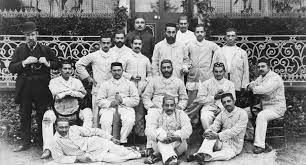
                                                  First Parsi team to U.K , 1886

Presidency Matches

The seed of cricket was first planted on Indian soil by the Britons. Among the Indians, the Parsees of Bombay were the first to try their hand at the ‘white man’s sport’.

In India the Britons and the Parsees were the first to have cricket clubs, Calcutta Cricket Club (1792) and Orient Cricket Club (1848) respectively. They were the first to play cricket among themselves and the first to promote the game on Indian soil.

The Parsees began to play against the Europeans to further their social and commercial interests. In 1877 Parsee CC beat a British side at a ‘friendly’ cricket match in Bombay. This incident happens to be the first instance of the Europeans losing to the local population on the sports field in any discipline on Indian soil. Unfortunately this fact has been conveniently ignored by our sports historians.

The advent of the great Parsee all-rounder Mehellasha Pavri (Tribute Posted Earlier) caused a flutter in the European camp in the late 1880s. His destructive bowling proved to be far too strong for the Bombay-based European expatriates. The Parsees were the first among Indian communities to defeat the colonial rulers regularly on the sports field.

 In 1889-90 a team from England, led by former Test cricketer George Frederick Vernon, arrived in India to play a number matches around the country. The very influential persona of Lord Hawke (Martin Bladen) came as a playing member. At Bombay the visiting Britons met their match as the Parsees humbled them.

These factors combined to make the Europeans in Bombay realize that to develop a meaningful resistance to the Parsee team, they must involve European players based in other Indian cities. The Governor of Bombay, Lord Harris (George Robert Canning) suggested that Europeans from neighbouring regions in the Bombay Presidency should be considered.

Lord Harris was a former Test cricketer of England and a very powerful influence on the corridors of England cricket. For a person of Lord Harris’ stature to acknowledge the undoubted class of the Parsee cricketers was a big leap forward for Indian cricket.

Thus from 1892 the Europeans announced that they would select a combined team with players from all over the Bombay Presidency. To include European players from beyond Mumbai was certainly a major step forward for Indian cricket at the time because it clearly indicated that the Europeans in India had come to respect the Indians' ability at cricket.

Two matches were played every year from 1892 to 1906, one in Mumbai and the other in Poona. These matches came to be known as Presidency Matches and are considered to be the earliest first-class matches played on Indian soil.

For 15 years, the two teams played each other 26 times with four matches being abandoned for either heavy rain or outbreak of plague, which was quite common at the time. The Europeans won 10 and the Parsees 11, with the honours shared in 5 matches.

The first centurion for the Parsees was DD Daruwalla, when he raced to 113 at Poona in 1903-04. However the credit for the only double century in the Presidency matches goes to Dr HD Kanga when in an innings of rare authority he smashed 233 at the Poona Gymkhana ground in 1905-06.

Here it must be recorded that most of the matches were played during the monsoon months. The wet pitches favoured the bowlers and consequently most of the matches ended in low scores. The reason for these cricket matches to be organized in the rainy season is an issue of perpetual conjecture.

Apart from the outstanding all-rounders Mehallasha Pavri and KM Mistry, the Parsee heroes were Rustomji Meherhomjee, a graceful batsman, the fast bowlers Baman Bilimoria, M.D. Bulsara, D.N. Writer and A.H. Mehta and the magnificent all-rounder N.C. Bapasola. BC Machliwalla, KS Kapadia and DD Kanga were consistent contributors as well.

 For the Europeans the prominent performers were John Glennie Grieg, a Jesuit priest, and an army man, Reginald Montagu Poore. Hard-hitting Poore’s 100 not out at Bombay in August 1895 was the first century of Presidency matches. Within months, by early 1896 the brigadier was representing South Africa in Tests against England.

 JG ‘Junglee’ Greig was the cynosure of all eyes with his elegance and consistency both with bat and ball. His was a calming, cultured influence which evoked respect from even his opponents. Reverend Grieg was the first man to highlight the awesome talents of the Hindu ‘Harijan’ cricketer, Palvankar Baloo (Tribute Posted Earlier).

Here it may be of interest to note that the famous England captain of the 1930s Douglas Jardine was born in Bombay in 1900 when his cricket-playing father Malcolm Robert Jardine was the Advocate-General of Bombay Presidency. The senior Jardine (born at Simla in 1870), former county player, represented the Europeans in Presidency matches.

The early Parsee cricket historians, Shorabjee Shapurjee Bengalee, Cawasji Jehangir and J.M. Framjee Patel, and later writers, Mehellasha Pavri and P.N. Polishwala deserve special mention. Without their classic treatises, the early chapters of Indian cricket would never have come to light.

These visionaries were the earliest patrons of Indian cricket. Every Indian cricket lover owes a deep sense of gratitude to the Parsees of Bombay who first planted the seed of the noble sport in the Indian mind.


Sunday, 27 February 2022


CK Nayudu

Sorabjee Colah had threatened to throw him overboard the ship-deck in 1932. In England in1936 Baqa Jilani abused him publicly and was rewarded with a Test cap for it by skipper Vizzy. Yes C. K. Nayudu evoked manic emotions in players under him.


Mushtaq Ali and the Holkar players worshipped him. The young Vijay Merchant was enchanted as he saw Nayudu pulverize MCC with 11 sixes at the Bombay Gymkhana ground in 1926. Lala Amarnath received his unstinted support as he raced to his Test debut century in 1933-34.


The person was none other than the legendary CK Nayudu. For Cottari Konkaiya Nayudu, cricket originated in ancient India and he always maintained that the supple and strong wrists oaf the Indians made them naturally adept at this game. Let it not be forgotten that Nayudu spoke of undivided India, an India which extended to Peshwar in the north-west periphery.


How true his reading was. Visualize the names of Fazal Mahmood, Hanif Mohammad, Zaheer Abbas, Majid Jehangir, Imran Khan, Javed Miandad, Sarfraz Nawaz, Wasim Akram in the company of our greats. Actually if petty political considerations had not partitioned us, undivided India would have ruled international cricket most certainly from the 1960s at least.


This was the dream that Nayudu had dreamt. At a time when Hammond, Hobbs, Bradman, Hutton, Headley and Constantine dominated world cricket, it took some guts to say that the sub-continent players were naturals and consequently the best. But then raw courage was his talisman, a constant companion.


Majestic CK Nayudu was a figure from the pantheon of cricketing gods. Over six feet in height, lissome of build, strong of arms. From his dark chisselled face radiated a halo that engulfed Indian cricket as no profile has done before or since.


In 1926 Arthur Gilligan brought a strong England (then M.C.C.) team to India to play a series of matches including unofficial Tests. At Mumbai against the combined Hindus team, Gilligan's men in exemplary fashion raced to 363 and then had the opposition Hindus in disarray at 84 for 3. In walked the ram-rod straight figure of C.K. and proceeded to play an innings which for sheer fire-power has had no equal.


C. K. reached his individual hundred in 65 minutes and then for good measure thrashed his way to 153 runs in just 115 minutes out of 187 runs added since his advent! A minor matter it was of 13 fours and 11 sixes against an attack that had Tate, Geary and the top professional bowlers of England at a time when English cricket ruled the world. Yes, you read right, no less than 11 over-boundaries.


It was not the statistical figure that had the Indian crowd walk ten feet tall. Nor the amazing speed of scoring. But the regal manner in which he unmasked the supposed superiority of the British Raj.


Like other subject people in Asia and Africa, the people of our sub-continent had come to believe in the invincibility of the White-Man, in thrall as they were for centuries. Perpetual servility had crept in, as it were. The Britons were far superior to ourselves, was the accepted notion.


In this context, the mayhem carried out single-handedly by CK Nayudu was a page out of the Mahabharata epic. If a singular act of defiance had raised the self-respect of Indians in those days of subjugation, this was it. Yes, CK Nayudu was the first Indian cricketer who made his own people believe that they could be just as aggressive as the best.


From that magical moment Indian cricket was no longer the same again. The morale of the Indian cricketers rocketed sky-high. The great barrier of the Englishman's invincibility had been broken down by one of their own and that too by one who was not of princely lineage but of ethnic stock.


Nayudu was born in an erudite Telegu family of Nagpur in 1895. The precocious talent for almost every ball-game was evident very early while still at Hislop Collegiate High School. His family encouraged him in every possible way and instilled in the young boy the sterling qualities of steadfastness and positive thinking, attributes which were to be his pillars of strength throughout his life in every endeavour.


It is commonly believed that while a youth he was encouraged by Ranjitsinghji, his father's colleague at Cambridge, to be more aggressive instead of being the plodder that he supposedly was at school. This appears to be apocryphal. For Ranji was no friend of Indian cricket and never encouraged any Indian cricketer.


Then again, CK was regularly hitting hundreds at school and surely no mere plodder could be reeling off hundreds and yet be regarded as a child prodigy. Lastly, later even when CK was at his best against the English in England or in India in the early 1930s, there was never a word of encouragement or admiration from the great Ranji.


Actually CK Nayudu was born and bred in India and was indeed fortunate that no foreign influence could curb his natural style. By 1915 at 20, he was selected to play for the Hindus in the Quadrangular tournament.


 On his debut against the strong Europeans he played as medium pace bowler and when the opportunity arose, he smote a six as his first scoring stroke. The bowler was Frank Tarrant, the brilliant Australian all-rounder who had come down to India to coach. It was no bravado, no desperation; just a hint to herald the positive nature and undoubted skills of this stupendously self-confident young man.


A man of great moral strength and physical courage, his penchant for physical training and constant practice had prepared him for an active first-class cricket career that spanned 48 years! From 1915 to the ripe old age of 66 in 1961 he virtually dominated the Indian cricket world.


 Like his famous peer Professor Deodhar, CK Nayudu too was in the habit of scoring double centuries in first class matches at a brisk pace while in his 50s and that too against the top-quality Indian bowlers. And so today when we hear that cricketers of the past were not physically fit enough, we can only smile at the ignorance of the uninitiated.


Indian selectors of the past however were no different from today's ‘jokers’. In 1932 for the tour of England the mantle of captaincy did not fall on the most deserving CK Nayudu because it was felt that only 'blue-blooded’ men had the ability to lead! Porbandar was elected to lead with Limbdi as his deputy. Disregarding the silly ideas of the national selectors,  both Porbandar and Limbdi were magnanimous to withdraw and allow Nayudu to lead in the inaugural Test at Lord’s in 1932.


 CK was magnificent as a leader and the team exhibited brilliant cricket earning genuine praise from all quarters. Nayudu at 37 scored a brilliant 40 on Test debut and made 1603 runs on tour, a landmark, including 5 centuries and was hailed by the cricketers’ Bible  “Wisden Cricketers’ Almanack" as one of its five cricketers of the year. Thus Nayudu was the first among Indians to be so rewarded.


Unfortunately not every Indian cricketer of the time appreciated his disciplined way of life. They found him a martinet who believed in total regimentation. In this we must readily admit they were not always wrong. For Nayudu, himself a product of elitist India, could not fathom the carefree nature of the simple rural India (Amar Singh) or the bonhomie of liberal education (Shute Banerjee). He rebuked Nissar for slackness in fielding but could have shown a little more restraint considering the fact that Nissar was bowling his heart out match after match.


Moreover Nayudu at a later period did himself no credit when he declined to play under Wazir Ali under a minor pretext. Yes, Nayudu, the master tactician that he was, had an Achilles' heel when it came to man-management. In CK's days, as of now, bias and prejudice have remained the bane of Indian cricket.


Back in India skipper CK duelled at par with Jardine, with whom he had a lot in common. Whereas Jardine had a disciplined brigade to handle, CK was in the midst of petty politicking throughout his tenure with mediocre mandarins perpetually carrying out cloak and dagger operations. On the 1936 tour yet again he scored more than a thousand runs with a magnificent 81 in the last Test. Even at 40 he was good enough to get runs against top international opposition.


But the petty officials at home finally did him in. Once he was invited to play a Test and on the morning of the match he was dropped for no apparent reason. The man who had given self-respect to the Indian cricketers was humiliated by stooges who craved for power even at the expense of the motherland.

  A man of charisma. Of presence. An embodiment of courage. Even in portraits he radiates an aura of respect.


Saturday, 19 February 2022


Prof Deodhar

 Dinkar Balwant Deodhar was born in Pune in1892 and from an early age was exposed to the legendary exploits of Shivaji Chattrapati. A staunch Hindu of impeccable credentials, to Deodhar cricket meant merely another route to attainment of salvation.

 If Pavri and Baloo, primarily by their exploits on tours to England, had fired the imagination of youth in those hoary days, it was left to Deodhar to give the Indians the taste of success first-hand. For the first time ever, a representative team of the colonial masters was subjugated by an Indian on Indian soil in full view of his countrymen. It appeared that Deodhar’s mission was to prove to the ruling Britons that the Indian subjects were capable of surpassing their best players at their own game.

 If any single Indian player can claim to have taken the country to official Test match status, it was most certainly the erudite Sanskrit scholar from Pune. On a winter morning in 1926, the grassy Bombay Gymkhana pitch laden with fresh dew beckoned the great fast-medium bowler Maurice Tate to exhibit his mastery as the India team faced the daunting task of facing Arthur Gilligan’s England (then MCC) team. This was the occasion for which the 34-year old Sanskrit pundit was waiting for years.

 Combining doggedness with exemplary strokes, Deodhar relentlessly went on and on. The imposing MCC total of 362 was passed and only then did the Sanskrit scholar allow his stupendous concentration to flag. He contributed a masterly 148 out of the team’s total of 437, a distinct lead of 75 runs over an England team comprising prominent Test cricketers.

 No longer would the Englishmen in India make fun of Indian cricketers; no longer would there be sniggers; no longer would anyone dare to take the Indians lightly. That day he was not only batting for his team, he was writing the script of self-respect of a people subjugated to indignities and worse. His innings would have made Kautilya proud.

 Skipper Arthur Gilligan, gentleman to the core, was enchanted by Deodhar’s innings of character and skill. Gilligan went back to England and took personal initiative to propose that India deserved to be among the nations playing official Test matches. Thus India came to join the Imperial Cricket Conference as an official Test team and made her debut in 1932 against England at the Lord’s.

 But such is the irony of this game that the man, who was primarily responsible to elevate India to official Test match status, never got a single opportunity to play Test cricket himself. When India went on her inaugural Test tour of England in 1932, the name of Deodhar was missing. An act of sacrilege, if ever there was one. By 1932 the cricket crusaders had given way to cricket conspirators. The new breed of administrators publicised that Deodhar at 40 was too old to play for the country.

 Yes, at 40 a cricketer may have been thought to be old by conventional standards. But Deodhar was not a man to conform to stereotype patterns. He was actually physically fitter than most not only in 1932 but also in 1936 when the second India team went to England. At that time he was a regular player for the Hindu team in the Quadrangular and Pentangular communal cricket tournaments as well as for Maharashtra in the Ranji Trophy. His prolific performance in the first-class cricket in the 1930s was far superior to most of the men who played for India at the time.

 He actually was a victim of conspiracy. This educated man was a free-thinking, liberated soul. He never formed groups. His individual streak and love for his own province forbade him from joining the service of the influential maharajas. Thus his erudition and upright character became a noose around his neck.

 However, it is to Deodhar’s credit that he took his fate in his firm strides. He played for Maharashtra till the age of 54! Even at that age he was prolific in his batting performance. At the age of 48, he scored 246 against Bombay and ultimately led his team to victory over Madras in the Ranji Trophy final.

 As if this was not unique enough, he scored a century in each innings against Nawanagar at the age of 52! Such is the irony of destiny. That a man who was eminently successful in his endeavours, had to remain a silent spectator because of the conspiracy and intrigues of his own countrymen.

 After retiring from the game, Deodhar was a very responsible national selector. Here too he left his imprint. He did not allow Anthony D’Mello, the Board President at the time, any favours. He was firmly opposed to D’Mello for trying to meddle in the selection of the national team. For this courageous approach of his, Deodhar suffered but then he could not be enticed to compromise with his principles. He was responsible for the rise of some of our genuine world-class players like Vinoo Mankad and Vijay Hazare.

 For a man’s of Prof Deodhar’s deep erudition and strong character, it was not the result but the effort that mattered. Rarely, if ever, we have seen such a karma-yogin on the cricket ground.

 Every Indian cricketer, of whatever hue, owes an eternal gratitude to these magnificent pioneers of Indian cricket. They laid the path and paved the way so that others could have a smooth passage. Let us not forget these immortal souls. Our very existence as cricketers and cricket lovers is because of their supreme sacrifices.

                                               I met Prof Deodhar just once. Way back in 1973. Bengal had just been beaten by Maharashtra in a Ranji Trophy quarter-final tie at Pune. That was our skipper Chuni Goswami’s farewell match for Bengal and the last match of my debut season.

 Inside the pavilion sat an elderly man with eyes glued to the match. Chunida asked me, “You always keep blabbering about cricket. Can you identify the gentleman sitting on the cane chair?”

I had a good look and asked, “Will he be Prof Deodhar?”

“Good. Then come I will introduce you to him.”

“But does he know you?” I asked.

Chunida gave a sidelong glance, “Everybody in India knows me.” Typical of Chunida, my captain.

As we went near the man, the elderly gentleman looked at Chunida and said, “Chuni, happy to see that you are still playing.” Chunida nodded and shook hands with him.

 The moment Chunida introduced me, the man said, “Good technique and temperament, but poor physique. Will never play for India.”

I was stunned by his assessment. Had a very successful debut season and played a fairly responsible innings in this match too. Yet the gentleman was so very discouraging. But, to be honest, he was dead correct. My physique was never strong enough. Suffered from a congenital heart ailment.

 Immediately I said, “Sir, I do not crave to be a Test player. I want to be like you.”

“What do you mean? Like me, in which way?”

“Sir, I want to be an academic first and only then a cricketer.”

The elderly gentleman smiled and grasped my hand, “That’s the spirit I like.”

That grasp was not the limp handshake of an 80 year old man. It was the Maratha grip that finished Afzal Khan. Full of steel and rock.


 The conversation with the living legend was enlightening. I did not want to let him go. He also seemed to enjoy my company. When I asked him about his cricket career, he merely said, “It is for others to judge. I was happy to have kept my backbone straight throughout.”

I quipped, “Sir, your protégés have answered on your behalf.” Furrowed his eyebrows and nodded.

“Sir, please consider me to be your Ekalavya.”

Did I see the suggestion of a strange smile cross his face? Did not say anything beyond, “In that case you will lose a lot.” When I touched his feet, he was visibly touched. Just said, “If you remain straight, God will always be with you.”

 He got up and strode out. Sturdy and strong. No support. Not even a walking stick. Every inch a philosopher-warrior. I had met my boyhood idol Chhatrapati Shivaji. The silhouette left, leaving behind an ever-lasting impression. He left just as he had spent his life. In splendid isolation.


Saturday, 12 February 2022


Palvankar Baloo

The first India born and bred cricketer of international eminence was a Harijan, a social outcaste. His name was Baloo Palvankar and he hailed from Dharwad, an obscure corner of Maharashtra.

Born in1875, his poverty-stricken family soon migrated to Poona. The young Baloo had to leave school early in life to augment the family income. His first job was with a Parsee cricket club where he rolled and swept the ground.

By 1892 however he got employment in the exclusive environment of Poona Gymkhana, where he was required to assist the chief groundsman. He also in his spare time bowled to the European players at the nets. One European Jungly Greig (more on him in another article) was the first to discover his exceptional talents.

Word soon spread that the young Harijan groundsman possessed outstanding bowling skills. But the high-caste, conservative Hindus of Poona would not even contemplate giving him a trial. In the caste-ridden ambience of Poona at the time, the low-born Harijan had little sympathy and less opportunity. Fortunately around this time Baloo’s father went to Bombay, where the cosmopolitan clime afforded him comparatively a little easier social mobility.

Here too, at the Hindu Gymkhana the orthodox elements were initially not in favour of playing with a low-born Harijan. But then regular defeats at the hands of the European and Parsee oppositions compelled them to include Baloo in their team.

Using all his skills he was an immediate success in the local matches, which made him an automatic choice for the combined Hindu team in the triangular tournament where the Hindus competed with the Parsees and the European expatriates. Immediately the Hindus began to win matches and titles. The primary reason was the fantastic exploits of the social pariah, Baloo.

From 1907 to 1920 he was the best bowler in the land. Left-arm spinner of phenomenal performance and remarkable consistency. Even though he was winning them trophies, the Hindus did not allow him to sit beside them even to have his cricket lunches!

Despite opposition from his own community to his leadership, late in life Baloo had the satisfaction to lead the Hindus to victory in the Quadrangular of 1920. This was most certainly a rare achievement. For a “low-caste” Hindu to give leadership to the supposed higher castes was indeed a major breakthrough in the social fabric of the Hindu community at the time.

For the sake of self interest and convenience, the upper class Hindus accepted a social outcaste to play alongside them. The man, who was judged to be an untouchable because of his birth, now became a hero because of his genius. In 1911 when the Maharaja of Patiala decided to take an all-India cricket team to England, Baloo was an automatic choice.

 In England, Baloo created havoc match after match. He did not worry about the cold, blistery weather. Nor did he find any time to bother about the ever-changing conditions and the varying pitches on which he had no experience earlier. The social pariah made no discrimination in his opponents as he teased and tormented the English batters.

He exhibited to the caste Hindus and the world what a social outcaste from an obscure village in India was capable of, if given the right opportunities. Later Baloo was joined in the Hindu team by his three brothers – Shivram, Vithal and Ganpat – each a brilliant performer in his own right. These four brothers made the Hindu team the best in the land.

 On his triumphant return from England in 1911, prominent social activists like Gokhale, Ranade and Tilak hailed his greatness in public announcements. Even Bhimrao Ambedkar, then a young student, became a self-confessed ardent fan of his.

 Whatever he got from cricket was not for his own benefit but for the benefit of the upper class Hindus. He and his brothers were merely pawns to be exploited and forgotten.

Baloo did not change his religious belief to Buddhism in response to a call from his friend and fan, Ambedkar, who was convinced that the ‘untouchables’ had no future within the Hindu community and so he wanted all his fellow ‘untouchables’ to convert themselves into Buddhists.

Baloo did not change his religion as he felt that with Mahatma Gandhi’s emergence and influence the status of his community would improve and that they would become an important part of the mainstream.

The contradiction in approach between the two friends drew them apart. In 1937, despite reluctance on his part, Baloo was coerced to fight an election against the formidable Dr Ambedkar and, as apprehended, lost the contest.

He died in 1955 in penury, thoroughly forgotten by the very men he had helped to prosper. Every Indian cricketer owes him an eternal debt. He is the first ever Indian cricketer who heralded the superiority of Indian cricketers to the world at large. He is the man who opened the door for the modern cricketer to earn respect abroad.

No national award, no national recognition, no financial benefit was ever granted to this dignified genius. He left behind the memory of a legend that should make every Indian cricket lover feel guilty of having forsaken him.


Sunday, 6 February 2022


Mehallasha Pavri     


Indian cricket owes a deep sense of gratitude to two scholarly individuals. One was Mehallasha Edulji Pavri and the other, Dinkar Balwant Deodhar. Pavri was a doctor by profession; Deodhar a professor of Sanskrit. Although their high noon was separated by about three decades, they were the real pioneers of Indian cricket who paved the path for posterity.


Pavri belonged to the Parsee community. Born at Navsari in 1866, he was drawn into the vortex of cricket in Bombay at a time when the mercantile Parsees were more than eager to befriend the ruling British community. For them cricked provided an avenue to socialize with the colonial masters. Learning the rudiments of the game from watching the Britons at the Bombay maidans, the Parsees decided that they too would have their own teams and play against the white men on equal terms.


It was easier said than done. The Britons in India did play against the Parsees but they were sarcastic, condescending and downright insulting at times. The affronts made the Parsees more determined than ever. They made up their mind to learn the game and compete as quickly as possible.  


Even as early as 1886 the Parsees went across to England to adapt themselves to the varying conditions and pitches. Only the elder cricketers of the community, who could afford to pay their voyage fares, went. Obviously enough, the team fared disastrously against the English who, at the time were certainly the best in the business.


Young Pavri was not in that 1st Parsee team which went to England in 1886. But by the time the team for the next tour of 1888 was selected, Pavri was an automatic choice by virtue of his stupendous performances against the Europeans in the Presidency matches on the Bombay and Poona maidans.


On English wickets he was a man inspired. He unleashed his thunderbolts with nagging accuracy. Stumps cart-wheeled with monotonous regularity. A natural athlete, he kept his ears and eyes open as he picked up finer skills from the masters of seam and swing, especially Lockwood. He added the break-back to his repertoire and felt equally at ease with the old ball as with the new.


By dint of his outstanding personal success, the profile of his team improved by leaps. Whereas in 1886, the Parsees had won just one match, losing 19 out of 28; this time the equation read : 8 victories and 11 losses out of 31 matches. A remarkable progress by any yardstick.


For Pavri, England was a revelation. In India the Britons had scoffed at the Parsees’ efforts, but in England the Britishers were genuinely generous with praise and guidance.


Pavri's extraordinary performance of 170 wickets at only 11.66 earned respect and plaudits. In a particular encounter with the Gentlemen of England at Eastbourne the Parsees left the Englishmen with hardly 120  runs for victory after being forced to follow-on. But that small target was enough for Pavri. His whiplash action bundled the Gentlemen for only 56 runs, claiming 6 wickets in the process. This was the match that heralded the rise of this magnificent bowler, the embryo from which Mohammed Nissar, Kapil Dev and company were to flower in the following century.


Such was Pavri's domination over Vernon's 1890 team in India as well as over Lord Hawke's 1892 side that he was invited to play for Middlesex in the county championship in 1895. Thus Pavri became the first Indian cricketer to have played in the county championships in England.


Ranjitsinghji is excluded from this category as he learnt and played his cricket basically in England. But then Ranji too first played county cricket for Sussex in the same year as Pavri, although Ranji had got his Cambridge 'Blue' in 1895.


Pavri played serious cricket till 1912 and then concentrated on his medical profession. Meticulous and methodical as befits his profession, he was a rare deity in the pantheon of Indian cricket. He authored an excellent book on cricket in India at the time.


His deeds heralded to the world that the Indians could well learn the game of cricket on their own and be as good as any in the world of men.